
I had wanted to visit Nepal for some time. Given my love of ancient cities and big mountains, it seemed like a place that I should have been to already, but it was only recently that I first journeyed there. My trip wasn’t part of a work-related writing assignment; it was the result of a plan I had started making with an old friend a few years ago. In the end, my friend lost his motivation to go, and as I don’t like giving up on something I have set my mind to, I went by myself.
Solo travel comes with some challenges—especially when intending to walk in the Himalaya—but it also offers some advantages. I think the greatest of these is the level of immersion you feel. When you are alone in a place you have never been to before, surrounded by an unfamiliar culture, your senses sharpen to help you take care of yourself and process all of the new information and stimuli you encounter. This can often make experiences seem more palpable.
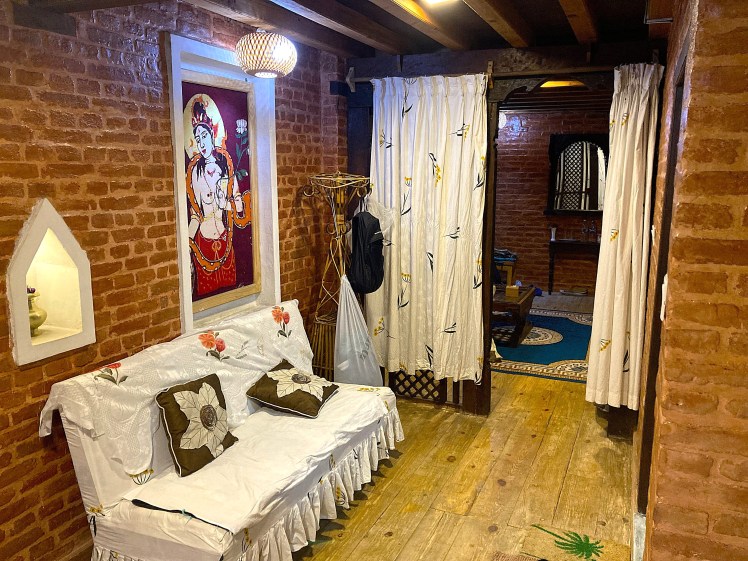
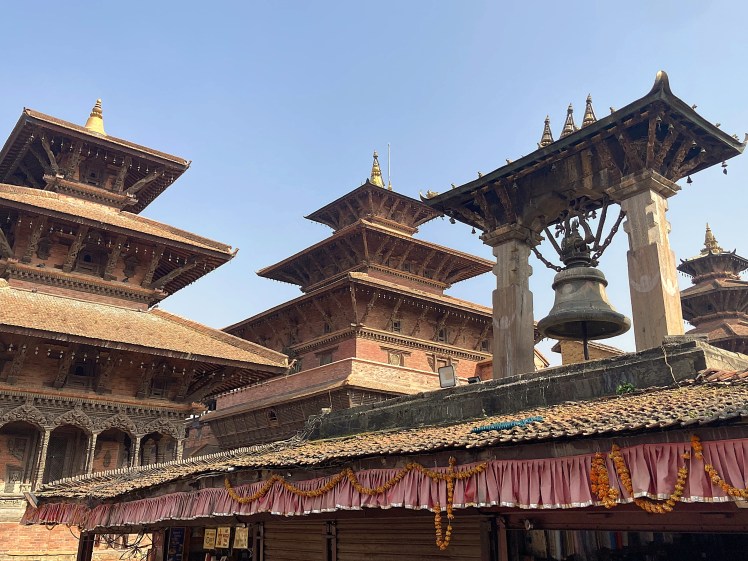
My flight to Nepal touched down in the evening, after a long journey from Tokyo that included a transfer in Bangkok. I then took a taxi through the lingering fumes and pollution of Kathmandu’s traffic to get to my hotel. I had chosen to stay in the municipality of Patan for the first few days of my trip. Patan is older than Kathmandu and has a more compact heritage district full of time-worn temples, courtyards and shopfronts that I wanted to explore.

There is something so freeing about waking up in a country different from the one you started the previous day in. It always feels like a clean canvas on which I can draw a colourful picture or a blank piece of paper waiting to host a new adventure story. Only the excitement of childhood Christmases comes close to matching the anticipation I feel before venturing out of the door on that first morning.

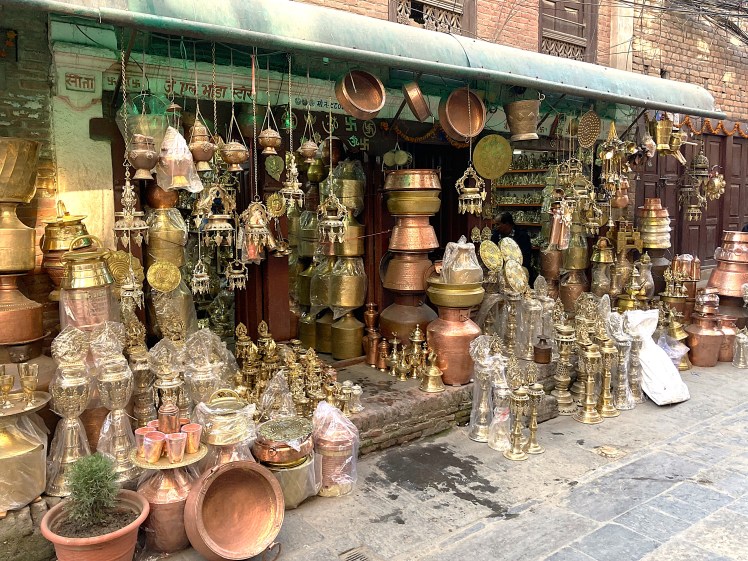
The narrow streets and hidden alleys of Patan (and parts of Kathmandu) have a lot to offer those who enjoy getting lost in a world of traditional craftsmanship. For hundreds of years, the area was a key junction along the trans-Himalayan trading route that ran between India and Tibet. Even today, skilled artisans use ancient techniques to produce their wares, and open-front buildings allow travellers to catch glimpses of metalworkers chiselling and hammering items into shape.
Some of the artisans are master goldsmiths who sculpt and fashion the resplendent religious statues that are scattered throughout the city’s temples. . . and Patan has a large amount of temples. Seeking them out was one of the activities I enjoyed the most during my time there—from grand, opulent edifices that dominate their environments to smaller, cosier sanctuaries that are easy to miss.

One of Patan’s most spiritually important Buddhist sites (the Golden Temple) is somewhere that I would have walked past without noticing, were it not for the distinctive guardians that stand watch over its entrance and a timely glance at my street map. Each temple has its own unique atmosphere, and after stepping through some gateways, I was surprised to be greeted by spacious interiors decorated with amazing art and statuary.

The highest concentration of impressive sites is clustered in and around Patan Durbar Square. In addition to its striking temples, Durbar Square is home to the Royal Palace of the former Malla kings, which now contains Patan Museum. The museum is well worth visiting and offers an informative visual insight into the cultural history of the city. The peaceful palace grounds include some fine features, such as an exquisite water tank adorned with Hindu deities.
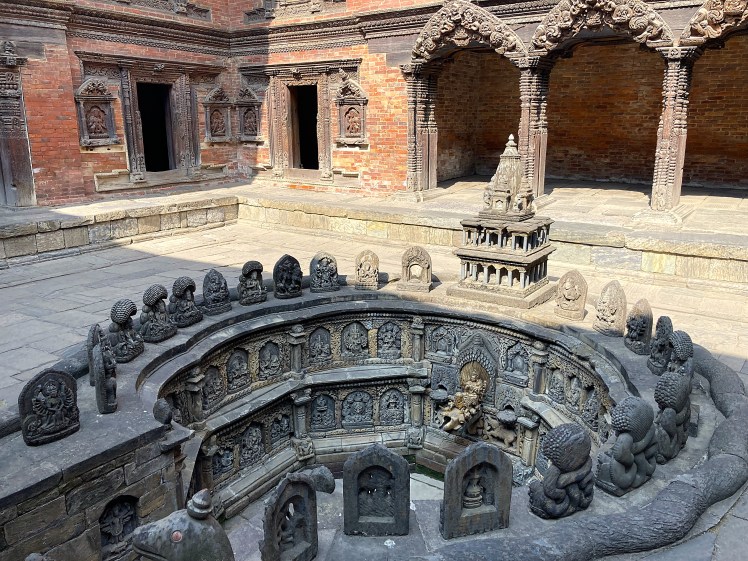
With its centuries-old religious sanctuaries and side streets that seem to have come straight out of a medieval Eastern fantasy world, Patan’s heritage district exudes an intoxicating combination of historical significance and exoticism. As I continued to wander its lanes, almost every turn revealed something interesting. Unfortunately, Patan sits in a seismically active hot zone and has been the victim of some big earthquakes during its existence.
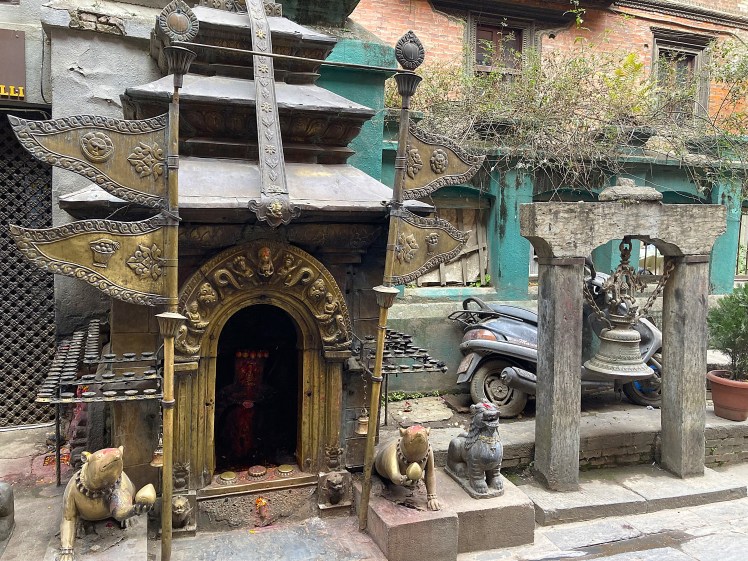
In 2015, a powerful quake caused extensive damage throughout Nepal and led to a large loss of life in both the cities and the mountains. It also destroyed many buildings in Patan and Kathmandu. Since then, some of those affected have been repaired or rebuilt, but huge cracks that are still visible in walls that were torn apart during the intense shaking and unfinished work on damaged structures act as reminders of the tragedy—and portents of what might lie ahead.

Despite the frightening effects of the planet’s tectonic activity, it is these same natural forces that led to the formation of Nepal’s most spectacular highlight, the high peaks of the Himalaya. The iconic mountain range was the main focus of my trip to Nepal. I had decided to trek in the Annapurna region, to the west of Kathmandu, and my access point would be the adventure hub of Pokhara, which I finally reached after a very bumpy and tiring nine-hour bus journey.

The area of Pokhara that most people choose to stay in (Lakeside) is brighter and more airy than Kathmandu and Patan. Located beside a large body of water called Phewa Tal, it has a relaxed atmosphere and is a great place to chill out for a while. The city has a few places of interest, such as the International Mountain Museum, but visitors tend to just use Pokhara as a base to prepare and gear up for whatever exciting high-altitude activities they have planned.

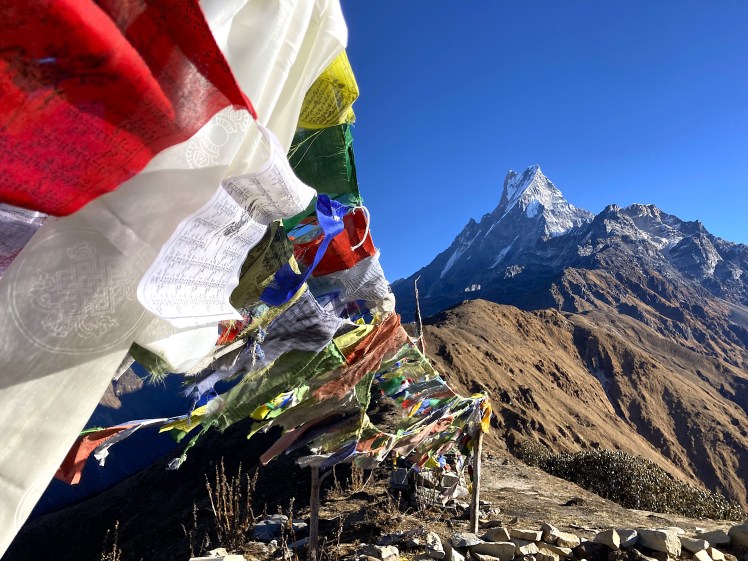
From the valleys and foothills that surround Pokhara, the snow-capped pinnacles of the Annapurna Himal rise up over colourful village homes and stalls in majestic fashion. Topping out at 8,091 metres, Annapurna I is the highest of the bunch, but I had long since been fascinated by another peak called Machapuchare (pictured below). Unlike Annapurna I, which was first conquered in 1950 by Maurice Herzog and Louis Lachenal, Machapuchare has never been summited.

In fact, climbing to the top of Machapuchare, which reaches a height of 6,933 metres, is officially forbidden. There is some uncertainty about whether this is because of a request made to the Nepalese government by British Lieutenant Colonel Jimmy Roberts (who led a team that stopped about 50 metres short of the summit in 1957) or because Machapuchare is venerated as a home of gods and sacred to the communities that live beneath its sky-piercing twin points.

Either way, the idea that its apex remains untainted by human beings in an age when there don’t seem to be many such places left in the world makes Machapuchare very special and appealed to my sensibilities. I had no intention (nor the skill) to attempt an illegal assault on its slopes, but I wanted to appreciate its virtue and purity from closer proximity. To do that, I embarked on a five-day foray from Pokhara that took me through some beautiful natural environments.

The Mardi Himal trek has gained popularity in recent years but is still much quieter than many others in the Annapurna region. It involves hiking through picturesque Gurung villages and verdant forests before ascending a spectacular ridge to a 4,500-metre viewpoint. Mardi Himal is the name of the peak that sits beneath Machapuchare, along the same ridgeline. The trek requires a good level of fitness and a sensible itinerary to allow for gradual altitude acclimatisation.

I was fortunate to have good weather and clear blue skies while I climbed. The views from some of the hill crests along the way were inspiring enough, but the higher sections of the ridge leading up to Mardi Himal provided a tremendous sense of scale. When I looked back, all of the lower peaks appeared to get sucked inwards towards the centre of a vaporous vortex that lay at the navel of the valley floor, 3,000 metres below.
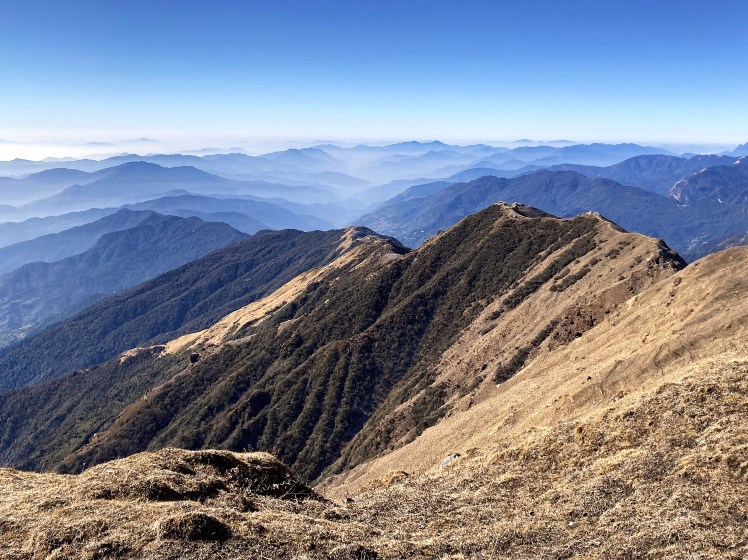
In the opposite direction, Tibetan prayer flags pointed the way forward as they flapped and fluttered in an ever-strengthening wind, sending their blessings of compassion and goodwill across the landscape and over the mountains to distant horizons. I was almost there now, but even after having come so far, Machapuchare still seemed distant—its virgin summit remained separated from me by 2,500 metres of vertical gain that I knew I would never surmount.
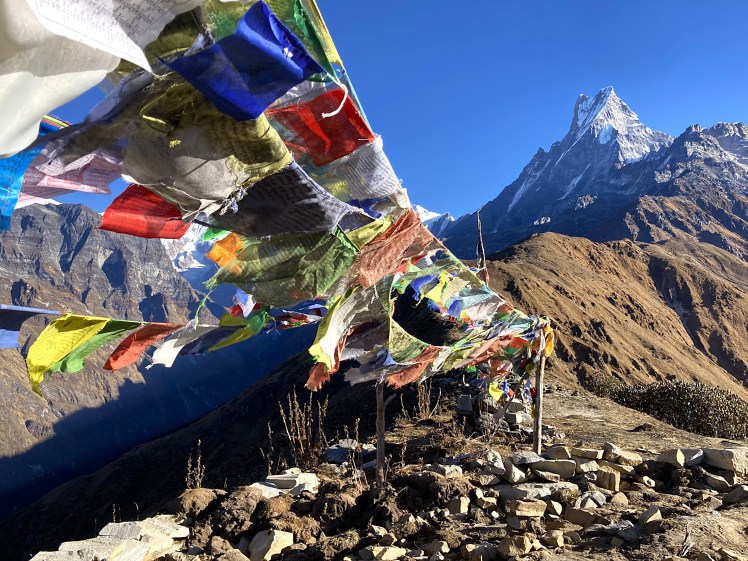
As I advanced along the final section of my planned route, the even taller peak of Annapurna South (7,219 metres) and its conjoined sibling, Hiunchuli, became more prominent. Their rugged profiles and razor-sharp edges seemed like a last act of wild defiance against the pacifying deep blue of a calm Himalayan sky. However, like so many of the world’s most incredible mountains, people set foot upon their summits decades ago.

With the ever-present possibility of changes to laws and climbing regulations, who knows what the future will hold for Machapuchare? For now though, it is unobtainable, and considering the expedition-related environmental problems that Mount Everest has been subject to, probably all the better for it. With an eye-catching elegance that surpasses most other peaks on the planet, it continues to watch over everything with an aloof and disinterested gaze. I like that.

There is enjoyment to be had in wondering what mysteries and treasures may lie just out of reach. Once we have visited a place, we make memories based on the reality we experienced, which can be very rewarding and satisfying. At the same time, it causes us to let go of all the other alternative possibilities that existed in our imagination and dreams before we went. Leaving somewhere unknown—to be explored only by the mind—helps us keep an extra blank page or clean canvas in our creative inventory to use as we please.

A Note on the Images:
The photographs featured in this piece were all taken by Philip S. Kay.
 Escape & Adventure